

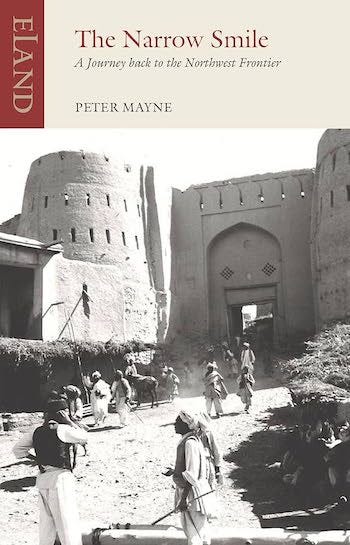
Peter Mayne was a Royal Air Force liaison officer on India’s turbulent North-West Frontier in 1941.
This harsh and barren region is home to the Pathans (or Pakhtuns), an ethnic group split into mutually hostile and often warring tribes ruled by an inviolable code of honour, who controlled the mountain passes that were the sole means of transport, extracting funds from passing caravans or raiding those who refused to cough up.
Mayne was one of the few British officers who didn’t evacuate after the disastrous and bloody 1947 partition of India. He went on to serve the government of Pakistan as Deputy Secretary to the Ministry of Refugees and Rehabilitation.
“A fairly solid group of British businessmen had stayed on in Karachi after partition,” he writes in The Narrow Smile, “and a nucleus of British officers of the old Government of India had accepted contracts under the new Government of Pakistan who were short of trained administrators and secretariat men. I had myself served Pakistan for the first two years of her existence. I still felt that I partly belonged to this country.”
Mayne moved to Morocco in 1949, which became the subject of another wonderful book, A Year in Marrakesh, also reissued by Eland, but he never forgot those tribal friends “that lurk like wolves on the borders of Pakistan and Afghanistan.”
And so he returned in 1953 to see what had become of them.
“Until the seventeenth or eighteenth centuries the Pakhtuns were known only to themselves,” he writes. “To the outside world they were a barbaric and violent people inhabiting the border country of what was, almost equally vaguely, called Afghanistan.”
“It is hard, cruel country on the whole, despite its cultivable valleys”, and that landscape created a hard people:
“The Pakhtuns were essentially nomadic peoples. There would be eternal inter-tribal fighting — over water, grazing grounds and the like. There would be mutual and continuing distrust. There would be a tendency for tribes occupying the valleys in relative ease, to grow relatively soft. Such a tribe, as it grew softer, would be raided by its tougher, highland neighbours. It might even be expelled from its cultivable valley in time, and take to the hills itself as the only available alternative.”
Seasonal migration between summer and winter grazing grounds had to go on despite this endless strife, and so a rudimentary code of honour evolved called the Pakhtunwali. It contained three categorical imperatives: “To give food and shelter to all who demand it, to grant asylum to all in need of it, and to retaliate against any form of attack.”
Mayne travels through the region, hitching rides in trucks and buses, to visit friends on all sides of the many tribal divides — friends who were often filing grievances with the British while conducting a little quiet raiding.
He paints a vivid portrait of these men as he joins them in tribal discussions, from time to time offering criticism in the form of gentle prodding. The tribesmen invariably respond with a twinkle in their eye or the hint of a smile, acknowledging that they don’t believe what they are saying, and are gleefully having it both ways. It was a game, and they were playing a role to the greatest advantage for themselves and their tribe.
The Narrow Smile is a fascinating portrait of a vanished world, one that provides insights into recent conflicts and the current state of a turbulent corner of Asia.
It is also a meditation on revisiting one’s past, and it was these sections I found myself reading again and again.
“I said good-bye with a nagging sense of yesterdays uprooted,” he writes. “Perhaps it was wrong to see old friends again: wrong, in any case, to meet just once for a few hours and then go away, leaving the past shaken out of its ordered and happily remembered frame, and the present fluid, with nothing to hold it in.”
Mayne writes of how our memories of the past impose themselves upon the present — “I kept thinking of what was gone, when I ought to have been content with each day as it came” — and of how difficult it is to return to a place we have known and loved and to see it for what it is today.
“Everything was the same as it used to be,” he says, “except for an emptiness and an oldness. My eyes noticed only the recognized things: the unfamiliar things didn’t count at all: and it was not until I realized this that I knew I must stop and readjust myself to today. The continuity of my life had been broken.”
It is, in a sense, the eternal Traveler’s Dilemma. Should you return to a place where you had profound experiences that shaped the course of your life? Would going back overwrite those early experiences? Will sadness and nostalgia for what was lost replace what you had?
Maybe what Mayne was searching for on the North-West Frontier wasn’t the Pathans, but the person he used to be?
“If I waited a little,” he writes, “if I kept watching through the split-cane screen of my doorway, would I come through the garden looking like a faded passport-photograph, and with me friends of another era young? Would they take no notice of the man behind the screen and pass by uncaring? […] Did it matter to me so much? I really don’t know, but I suppose it did. I only knew that after all reaching back was impossible, and that I should destroy these images once and for all time. I must exorcize the ghosts, amongst them the faded ghost of me so long before. I ought to have been able to laugh at them by now – and they could certainly sit back and laugh at me, because in the end the most I could do to them was to make a symbol of the deaths they should have died in whatever year it was.”
Peter Mayne may have wished he had left those memories untouched. But I, for one, am glad he didn’t.
Sounds good Ryan. I like the idea that they " stayed on" after independence. I will try to track it down.